


Ignatius Maloyan, Armenian archbishop and martyr: soon to be canonized by Pope Leo XIV
Aline Haddad
Friday, September 26, 2025
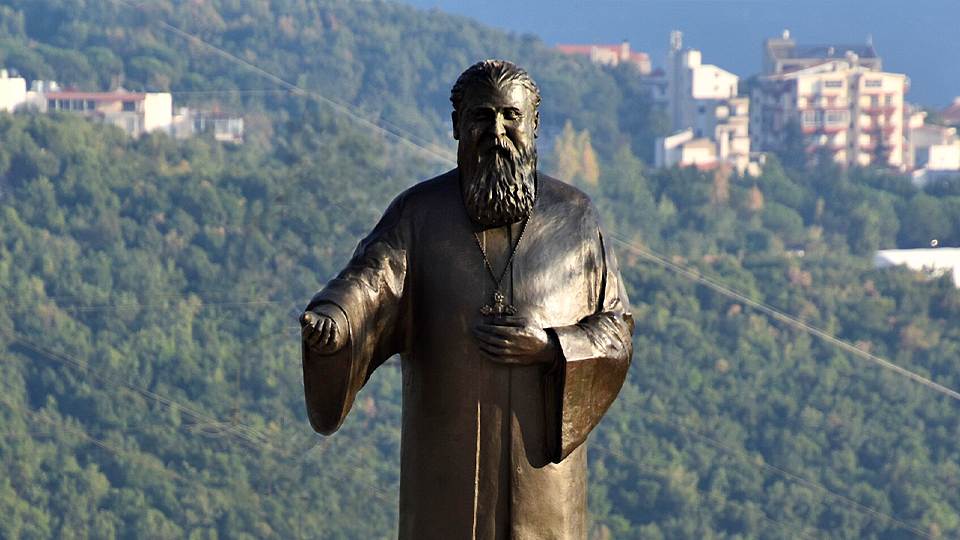
Statue of Blessed Ignatius Maloyan, Bzommar, Lebanon. Wikimedia Commons.
On October 19, 2025, Pope Leo XIV will proclaim Ignatius (Choukrallah) Maloyan, Armenian Catholic archbishop of Mardin, a saint of the Church. His canonization marks an important milestone not only for the Armenian Catholic Church, but also for the entire universal Church, for all those who, yesterday as today, bear witness to Christ in the midst of persecution: a testimony of faith, courage, and fidelity to Christ to the very end. Who was this pastor who preferred to die rather than renounce his faith?
A life devoted to God
Ignatius Maloyan, born Choukrallah Maloyan, was born on April 19, 1869, in Mardin, in the Ottoman Empire, now Turkey. His birth name, Choukrallah, literally means “thank God.” This choice was not insignificant: it reflects the depth of his family's faith and their gratitude to God for the gift of life. Every time his loved ones called him by his first name, it was an act of gratitude and a prayer in itself, a simple but powerful way of keeping alive the relationship with the divine on a daily basis. Thus, from childhood, Maloyan grew up in an atmosphere marked by piety, thanksgiving, and fidelity to the faith, values that would shape his entire spiritual and pastoral life. As a teenager, he felt the call to the priesthood and entered the Armenian Catholic seminary in Bzommar, Lebanon, at the age of 14. After completing his higher education in 1896, he was ordained a priest at the church of the Bzommar monastery. He became a member of the Bzommar Institute and took the name Ignatius in memory of the famous martyr of Antioch, St. Ignatius of Antioch. Between 1897 and 1910, Fr. Ignatius was appointed the parish priest of Alexandria and Cairo, where his good reputation was widely known. In 1911, Pope Pius X appointed him Archbishop of Mardin during the Synod of Armenian Bishops in Rome. The synod itself was focused on Turkey’s evolving political circumstances as the Young Turks movement rose in prominence. A zealous pastor who was close to his people, he distinguished himself through his concern for the poor, his pastoral commitment, and his desire to reconcile and teach in a context marked by religious and political tensions. In 1915, after the Ottomans entered World War I, they targeted Armenian Christians in their territory for army conscription and general violence. This would eventually boil over into genocide. Amid the turmoil, Archbishop Maloyan was arrested along with 13 priests and 600 other Christians at the same time.He was offered his freedom in exchange for renouncing Christianity and converting to Islam. His response was firm:“If Jesus Christ, my Lord and my God, was crucified for me, why should I not be ready to die for Him too?”Archbishop Maloyan and his companions were executed on June 11, 1915 after refusing to renounce their faith. He died proclaiming the name of Jesus.
From beatification to canonization
Recognized as a martyr, Archbishop Maloyan was beatified by St. John Paul II on October 7, 2001. In his homily, the pope emphasized his testimony as a sign of hope for persecuted Christians. In June 2025, Pope Leo XIV approved his canonization. The ceremony will take place on October 19, 2025, in St. Peter's Square in Rome, in the presence of many Armenian faithful and pilgrims from around the world. Through the canonization of Ignatius Maloyan, the Church not only celebrates the faithfulness of a man of faith. It also pays tribute to the memory of the genocide that claimed the lives of 1.5 million Armenians, Assyrians, and Greeks — peoples who suffered and sacrificed themselves to preserve their faith and identity. Archbishop Maloyan thus becomes the face of anonymous Armenian martyrs, reminding the world that their sacrifice was not in vain. His canonization is therefore an act of historical and spiritual justice, a universal recognition that inscribes their testimony in the memory of the Church and of humanity. The canonization of Archbishop Maloyan has special significance not only for Armenians and Lebanese people, but also for Christians throughout the Middle East. In a region still marked by war, persecution, and uncertainty, his witness of faith and sacrifice becomes a source of courage and hope. Despite these difficult circumstances, many faithful are expressing their enthusiasm and preparing to travel to Rome on October 19 to experience this historic moment.Memorial and liturgical feast
The liturgical feast of Blessed Ignatius Maloyan is celebrated on June 11, the day of his martyrdom. He is particularly honoured in Lebanon, Armenia, and among the Armenian diaspora. The Lebanese President will be present in Rome for this occasion, following an official invitation from Patriarch Catholicos Raphael Bedros XXI Minassian. Many Lebanese and Armenian Catholics are preparing for the big day. A website has been created to organize these trips from Lebanon to the Vatican. The Salt + Light Media team, represented by its President and CEO, Fr. Haig Chahinian, will also travel to Rome for media coverage and exclusive interviews on this occasion. The Mass of Canonization will be broadcast on Salt + Light TV on the day. Stay tuned for more information. Through the canonization of Archbishop Ignatius Maloyan, the Church reminds us that holiness is not a distant idea but an incarnate reality: men and women, in the darkest moments, have chosen to remain faithful to the light. Maloyan’s example challenges each of us: How can we, in turn, bear witness to Christ in our daily lives?




Related Articles:
<<
SUPPORT LABEL
$50
$100
$150
$250
OTHER AMOUNT
DONATE
Receive our newsletters
Stay Connected


Receive our newsletters

Stay Connected