


What kind of Church are we called to be? “Go and do likewise” | As I have loved you
Julian Paparella
Monday, March 9, 2026
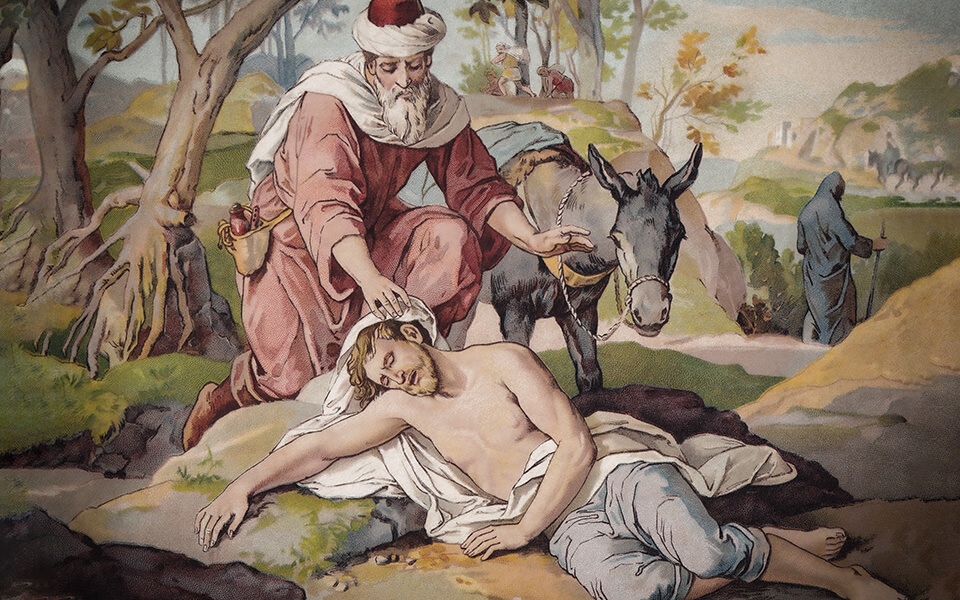
The Parable of the Good Samaritan, based on Julius Schnorr von Carolsfeld. iStock image.
What kind of Church are we called to be? “Go and do likewise”
A reflection on Chapter 3 of Dilexi Te
Last week’s reflection focused on how God chooses to be on the side of those who experience poverty, exclusion, marginalization, and suffering. Seeing God in these terms can change our understanding of who God is and how he sees us. God is not a demanding overlord but a compassionate redeemer who remains especially close to those who are most in need. If that is how God is, then what does this mean for the Church? Chapter 3 of Pope Leo’s Apostolic Exhortation Dilexi Te sheds light precisely on this question.A Church of the Poor
If God is for the poor, then the Church must also be for the poor. It is in this light that we can understand Pope Francis’ well-known statement: “How I would like a Church that is poor and for the poor!” It was with these words, just days after his election as pope in 2013, that Francis explained how he chose his name. In the moments following his election, a fellow cardinal from Latin America sitting near Francis whispered over to him: “Don’t forget the poor.” In order to keep the poor at the heart of his ministry as the leader of the world’s Catholics, the pope from the peripheries chose St. Francis of Assisi as his papal namesake. Francis of Assisi came from a well-to-do family. His father was a wealthy silk merchant, and his mother came from a noble French family. He lived the high life throughout his youth, dressing lavishly and spending money extravagantly. The story goes that one day he was selling his fine fabrics in the marketplace for his father’s business. While Francis was serving customers, a beggar came up to him asking for money. Francis told the man to wait in line. As the man walked away, Francis ran after him and gave him everything in his money purse. A similar moment came several years later, as Francis rode his horse by a leper on the side of the road. Francis initially feared the man, but eventually got down and approached him, kissed his hand and gave him his garment. As Francis continued on his way, he looked back but the man had disappeared. Francis realized in that instant that he had not merely encountered a leper, but Christ himself! That was a turning point in St. Francis’ life. He renounced his wealthy upbringing and embraced poverty in order to follow Christ more closely and devote himself fully to serving those in need. Francis saw in those who are poor and suffering the face and flesh of Jesus. As Pope Leo observes, “Francis’ poverty was relational: it led him to become neighbour, equal to, or indeed lesser than others. His holiness sprang from the conviction that Christ can only be truly received by giving oneself generously to one’s brothers and sisters.” (DT #64) The pattern of Francis’ life and relationships is a source of inspiration for the entire Church. If we are to be centred on Christ, we cannot keep those who are poor and suffer – those who bear the face of Christ – on the outskirts. They must be the centre of the Church’s attention, as they are for Christ.
Saints of the Poor
The lives of countless saints can inspire us to be a Church that keeps those who live in poverty and suffering in our minds and hearts. We can think of the many religious communities of women and men across the ages who have dedicated their entire existence to caring for the sick, visiting prisoners, welcoming strangers, and educating underprivileged children – living out Jesus’ message in Matthew 25.St. Lawrence, deacon and martyr
Right from the first Christian communities, the poor had a privileged place in the Church. In the first centuries of Christianity, while Christians were being martyred by the Roman Empire, St. Lawrence served as a deacon for Pope Sixtus II in the city of Rome. At one point Lawrence was ordered by the Imperial authorities to turn over the treasures of the Church. When the day came to hand everything over, he brought with him the poor that he ministered to. When the authorities balked, Lawrence simply replied, “These are the treasures of the Church” (DT #38). Lawrence was ultimately martyred, but the power of his testimony rings true to this day.St. John Chrysostom, preacher of love for the poor
Lawrence’s witness recalls the words of St. John Chrysostom, one of the most renowned fathers of the Church. Like St. Francis centuries later, he called upon the faithful to recognize Christ in those in need. He preached:Do you wish to honor the body of Christ? Do not allow it to be despised in its members, that is, in the poor, who have no clothes to cover themselves. Do not honour Christ’s body here in church with silk fabrics, while outside you neglect it when it suffers from cold and nakedness… [The body of Christ on the altar] does not need cloaks, but pure souls; while the one outside needs much care. […] So you too, give him the honour he has commanded, and let the poor benefit from your riches. God does not need golden vessels, but golden souls (#41).The treasures of the Church are not gold chalices or the artifacts in the Vatican Museums, but those who are most precious in the eyes of Jesus, with whom he identifies personally. They must be at the very heart of the Church’s life and mission. We cannot truly encounter Christ on the altar if we are not willing to encounter him in those who sleep out in the cold on the doorstep of the church.
Mother Teresa, universal icon of charity
Within our own lifetimes, we can think of the prophetic example of Mother Teresa. She was once asked by a journalist what keeps her going as she cares daily for the dying and the abandoned. Without batting an eye, she raised her hand reaching out her five fingers and said, “Five words: You did it to me.” As Leo puts it, Mother Teresa “has become a universal icon of charity lived to the fullest extent in favour of the most destitute, those discarded by society” (#77). Mother Teresa lived what she preached in a radical way:We are wanting to proclaim the good news to the poor that God loves them, that we love them, that they are somebody to us, that they too have been created by the same loving hand of God, to love and to be loved. Our poor people are great people, are very lovable people, they do not need our pity and sympathy, they need our understanding love. They need our respect; they need that we treat them with dignity (“Speech on the occasion of the awarding of the Nobel Peace Prize,” 10 December 1979).In Leo’s words, Mother Teresa “did not consider herself a philanthropist or an activist, but a bride of Christ crucified, serving with total love her suffering brothers and sisters.” (#77) Inspired by the saints, we can ask ourselves: how do we show God’s love for those in need? Are our families, parishes, and communities places that welcome those who are poor, sick, and suffering? What place do they have in our hearts and in our priorities? Are we willing to devote time and resources to easing their hardships? Are we willing to recognize Christ in them? As Pope Leo reminds us,
Christian holiness often flourishes in the most forgotten and wounded places of humanity. The poorest of the poor — those who lack not only material goods but also a voice and the recognition of their dignity — have a special place in God’s heart. They are the beloved of the Gospel, the heirs to the Kingdom (cf. Luke 6:20). It is in them that Christ continues to suffer and rise again. It is in them that the Church rediscovers her call to show her most authentic self (#76).Jesus, open our ears to the radical call of the Gospel. Open our eyes to seeing You in those in need. Open our hands to offer what we have, and transform our hearts to become more like Yours. Amen.





Related Articles:
<<
SUPPORT LABEL
$50
$100
$150
$250
OTHER AMOUNT
DONATE
Receive our newsletters
Stay Connected


Receive our newsletters

Stay Connected