


St. Patrick: Courageous bishop and missionary
Maria Montemayor
Sunday, March 15, 2026
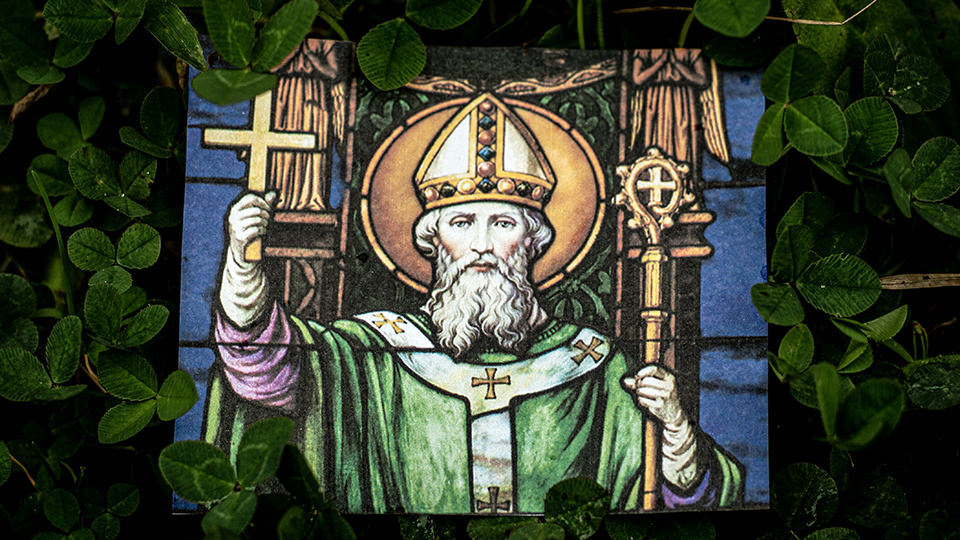
Photo by Carolina BR on Cathopic.
Christ be with me, Christ within me, Christ behind me, Christ before me, Christ beside me, Christ to win me, Christ to comfort and restore me, Christ beneath me, Christ above me, Christ in quiet, Christ in danger, Christ in hearts of all that love me, Christ in mouth of friend and stranger.
- Excerpt from “The Breastplate” by St. Patrick
People often associate St. Patrick's Day with wearing green and drinking beer, but who exactly was St. Patrick, and why do we celebrate him? The patron saint of Ireland was born in Britain in the 4th century AD to wealthy and loving parents. His father, Calpurnius, was a deacon and local official. Although his family was Roman and Christian, Patrick did not grow up close to Christ which makes his missionary zeal and legacy even more inspiring to us today..
When he was 16, Irish raiders arrived at his village and kidnapped him and thousands of other people. He was brought to Ireland and sold into slavery. For six years, he worked as a shepherd, which was lonely and laborious. He was accustomed to comfort, but now he had to travel through harsh climates and deal with difficult terrain. During this time, he began to pray. He got into the habit of praying many times a day, which increased his love for God and deepened his sense of God’s providence and protection. He would wake up before daylight to pray even if it was snowing, freezing, or raining. The Holy Spirit was turning his heart towards Christ.
One night, he heard a voice in his dreams telling him that he would depart for his home country and that his ship was ready. The following morning, he ran away from his master and found a ship that took him back across the Irish Sea to Britain. While at home, he started to study Scripture and the Catholic faith. He struggled to fit back into society, as he had prayed in the Irish wilderness for years and missed out on six years of education. He then had another dream: the people he had met in Ireland were begging him to return. He believed that through this dream, God was calling him to convert the pagans in Ireland. He received theological training in France, was ordained a priest and, at 43 years old, was consecrated as a bishop. Due to his understanding of Irish culture and language, the Church confirmed his missionary vocation and sent him back to Ireland.
St. Patrick used the shamrock, which has three leaves, to describe the Father, the Son, and the Holy Spirit as part of one God. His life as a missionary was not easy: he encountered opposition from pagan druids, and martyrdom was always on the table. However, he strongly believed in his vocation and journeyed across the country preaching, baptizing, and confirming with zeal. He completely trusted in God and his mission bore fruit. Thousands of people converted to Christianity, churches were established, and religious vocations flourished.
What can we learn from St. Patrick's story? One lesson is that God can turn our darkest times into opportunities to turn to Him in prayer, faith, and trust. It was only when St. Patrick was stripped of his comfortable and peaceful life that he was able to develop a prayer life and grow closer to God. Another lesson is that it's never too late for us to make a difference in the world and live out God's calling for us. St. Patrick missed out on six years of formal education and only started his missionary work after he became a bishop at the age of 43. The older we get, the more we feel like it's too late to make a career change, go back to school, volunteer abroad, get married or discern the priesthood, so on and so forth. St. Patrick's story reminds us that we can achieve God's calling for us if we rely on Him, heed His small nudges, trust in His timing, and discern His holy will through prayer.

Share with friends:




Related Articles:
<<
SUPPORT LABEL
$50
$100
$150
$250
OTHER AMOUNT
DONATE
Receive our newsletters
Stay Connected


Receive our newsletters

Stay Connected