


At the Port of Beirut, Pope Leo XIV's prays for hope for Lebanon
Aline Haddad
Monday, December 1, 2025
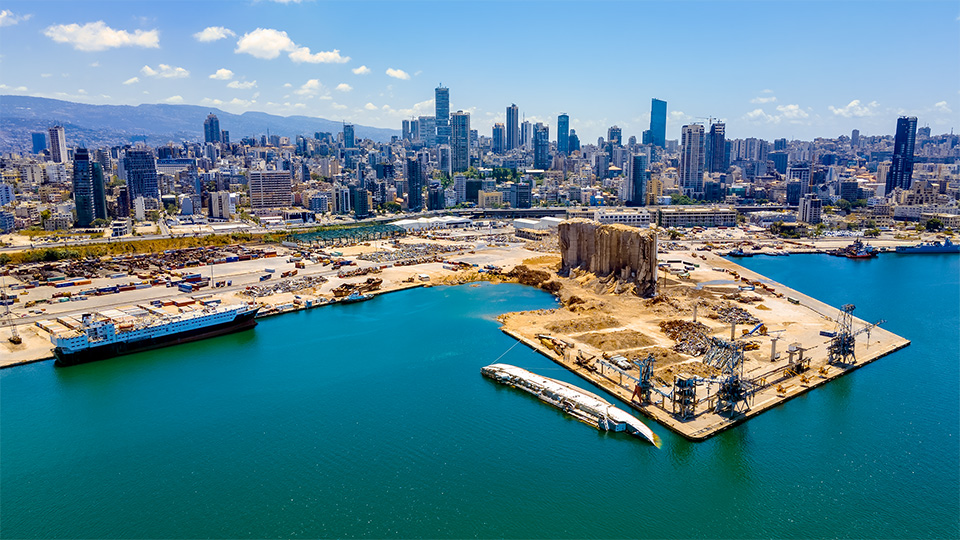
The Port of Beirut, where Pope Leo XIV is visiting to offer a prayer for peace and hope. It suffered a massive explosion on August 4, 2020. iStock Photo.
Lebanon is known for its unique religious diversity: there are officially eighteen communities recognized by the state. Among them, Christianity occupies a central place and is divided mainly between Orthodox and Catholic Churches.. On the Catholic side, there are several Eastern Churches in communion with Rome, notably the Maronite Church — the largest — as well as the Melkite Greek Catholic, Armenian Catholic, Syriac Catholic, Chaldean, and Latin (Roman) Churches. Each has its own liturgical, spiritual, and cultural heritage, contributing to the country's religious mosaic.
This diversity has profoundly influenced not only Lebanese culture, politics, and architecture, but also the population itself, shaping society.
While the Lebanese political system remains strongly sectarian, everyday reality is very different. Lebanese men and women live, study, and work together with great spontaneity. I remember a class I took in downtown Beirut: there were twelve of us students, each from a different community. This diversity created no barriers; on the contrary, it was and still is a source of richness. It is often when politics gets involved that tensions reappear, as if some people were trying to apply the old principle of “divide and rule.” This duality between joyful unity in everyday life and tense divisions in political life is a reality deeply rooted in the Lebanese experience.
Lebanon has always been a land marked by tensions: centuries of conflict, wars of succession, and foreign invasions have shaped its history. Various civilizations — the Romans, Persians, Ottomans, French, and many others — have occupied this territory in turn, sometimes taking advantage of local divisions. The most recent civil war, from 1975 to 1990, ended with a Syrian occupation that lasted fifteen years. A non-violent mass demonstration for Lebanese independence and democracy in 2005 succeeded in securing the withdrawal of Syrian forces. However, the shadow of occupation and rivalries has never completely faded.
The last five years
Over the past five years, Lebanon has endured some of the most difficult trials in its recent history:- A financial collapse in 2019, sparked by a popular uprising that led to a banking crisis, wiped out the savings of an entire population and dissolved a once-strong middle class.
- The sharp devaluation of the Lebanese pound led to rampant inflation and made access to essential goods increasingly difficult;
- The COVID-19 pandemic struck amid the chaos, exacerbating poverty, social fragility, and difficulties in accessing healthcare;
- Then came the explosion or blast at the port of Beirut on August 4, 2020: one of the most violent non-nuclear explosions in modern history, it devastated the capital, causing several hundred deaths, hundreds of thousands of displaced persons, and more than $10 billion in damage. According to Vatican News, the investigation into the blast has been muddled, blocked, contested, and manipulated according to various interests. Many Lebanese men and women have come to fear that the truth will never be fully revealed and that it will remain buried under pressure, threats, and official silence.
- Finally, in 2024, a new war along the southern border, marked by bombing and massive destruction, forced more than a million people to flee, rendering certain areas uninhabitable.
The visit of Pope Leo XIV, a messenger of peace
Pope Leo XIV's historic visit to Lebanon, which began on November 30 and continues to December 2, 2025, takes on particular significance after years of suffering and hardship for the country. He comes bearing a message of peace and hope—not only to the Lebanese people at home, but also to the entire Lebanese diaspora, who anxiously follow the fate of their country. Leo XIV is not the first pope to set foot on Lebanese soil: three of his predecessors have already done so:- Paul VI visited Beirut on December 2, 1964, during a stopover on his way to India.
- John Paul II visited Lebanon on May 10 and 11, 1997 to conclude a special synod for Lebanon. In his post-synodal apostolic exhortation, A New Hope for Lebanon, he declared that Lebanon, “became a Holy Land by the passage of the Saviour.”
- Benedict XVI went there from September 14 to 16, 2012. Pope Francis reflected on this visit at the beginning of his pontificate the next year: “We saw the beauty and strength of the communion of Christians in that land and the friendship of so many of our Muslim brothers and sisters and many others. It was a sign for the Middle East and for the whole world: a sign of hope.”
The Pope's prayer at the site of the explosion in the port of Beirut
On December 2, the pope will offer a prayer at the site of the Beirut port explosion. This moment of prayer goes far beyond a symbolic gesture: it has a profound spiritual dimension. It is addressed to the Lebanese people, especially the younger generation who, discouraged by instability, forced exile, or loss of hope, are seeking a life elsewhere. Standing before the ruins of the port, the Holy Father reminds us that this land is not just a wounded geography or the subject of a muddled investigation, but is a land of mission, faith, history, and vocation. His Excellency Paul Marwan Tabet, Bishop of the Eparchy of St. Maron of Canada, reflected on this upcoming moment:Pope Leo XIV's prayer at the site of the Beirut port explosion can be interpreted as an explicit call for global justice. By choosing this place steeped in pain, he reminds us that the disaster is not just a past event, but a wound that is still open for those who continue to suffer: the wounded, the families of the victims, the traumatized inhabitants, the destroyed capital of Lebanon, and all those who have lost everything. Through this gesture, he emphasizes the need to shed light on all responsibilities, whether individual, institutional, or related to gross negligence, and to obtain dignified justice for the innocent victims. His presence thus embodies powerful moral support and an invitation to the international community not to look away until the truth has been fully established and reparations have been made.The pope's prayer at the port connects heaven and earth, hope and responsibility, faith and justice. It reminds the Lebanese people that their pain is seen, carried, recognized, and that despite the opaque mechanisms that attempt to stifle the truth, there is still an outside perspective that calls for transparency, dignity, and true healing. You can follow our coverage of Pope Leo XIV's Apostolic Journey to Lebanon today and tomorrow on Salt + Light TV and Salt + Light Plus. Visit slmedia.org/turkiye-lebanon to learn more.

Categories:
Share with friends:




Related Articles:
<<
SUPPORT LABEL
$50
$100
$150
$250
OTHER AMOUNT
DONATE
Receive our newsletters
Stay Connected


Receive our newsletters

Stay Connected