


Who is John Henry Newman? A new Doctor of the Church teaching Lessons for the Heart
Julian Paparella
Tuesday, December 2, 2025
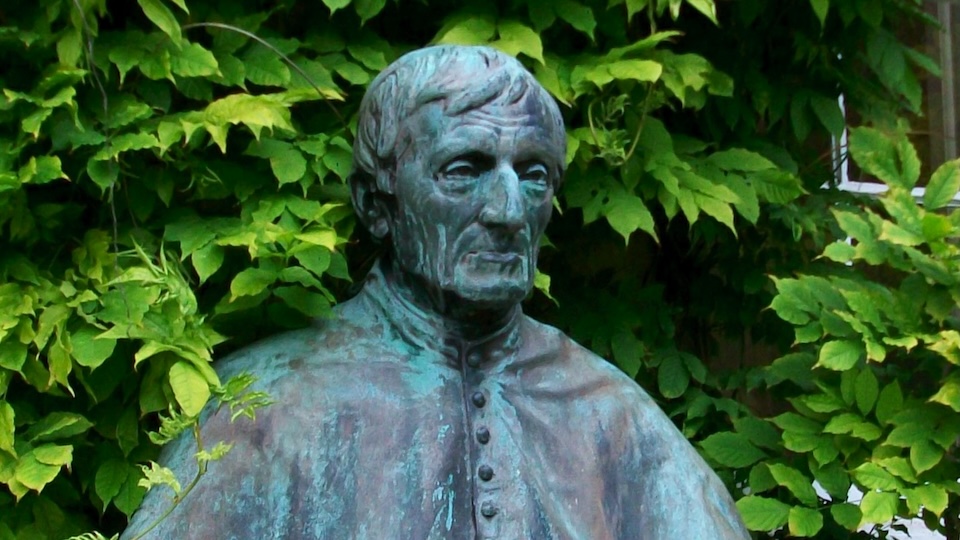
Bust of St. John Henry Newman at Trinity College, Oxford. Wikimedia Commons
It was a moving experience to be at Mass in St. Peter’s Square on November 1st, the Solemnity of All Saints. I was especially moved witnessing Pope Leo XIV declare St. John Henry Newman a Doctor of the Church. Newman (1801-1890) had been beatified by Benedict XVI in 2010 and canonized by Pope Francis in 2019. He has now become the newest of the only 38 Doctors of the Church in the two-millennia history of Christianity.
So who was Newman and what does it mean that he is now a Doctor of the Church?
Doctors of the Church are first and foremost teachers that the universal Church lifts up for future generations. Doctor in this case comes from the Latin word for “teacher.” They are men and women who are recognized across the universal Church not only for their holiness, but also for their exceptional contributions to Christian theology and Church teaching.
Newman’s thought has had a profound impact on Catholic teaching over the course of the past century, and he was among the most cited intellectual figures during the proceedings of the Second Vatican Council. His thought was especially influential in the drafting of Vatican II’s Dogmatic Constitution of Divine Revelation Dei Verbum, particularly his notion of the development of doctrine, as well as the Declaration on Religious Freedom Dignitatis Humanae, especially on the topic of conscience. Newman’s legacy includes the Newman Centres, which are hubs of Catholic campus ministry at universities around the world. I first got to know Newman as an undergraduate student, when I lived and worked at the Newman Centre at McGill University in Montreal. As Matthew Neugebauer explained in a previous blog, Newman has also significantly influenced the path of synodality that the Church is currently undertaking, since he was a strong advocate for equipping, consulting, and partnering with lay people and he understood that Church teaching naturally develops over time.
There is no question that Newman had a brilliant mind and was a prolific writer. He is perhaps the most significant theologian of the 19th century, certainly in the English-speaking world. Yet what I admire most about Newman is the way he put his life on the line to be faithful to his faith, abandoning himself with radical trust in God.
St. John Henry Newman was not a martyr in the strict sense. He did not die for his faith. Yet he was willing to lose everything to stay true to what he believed. The title of one of his biographies captures this well: “A life sacrificed.” By converting from Anglicanism to Catholicism, Newman went from being a prestigious professor at Oxford and a highly respected Anglican priest to a social reject, a pariah. He lost his job. His reputation was torn asunder. His friends abandoned him.
Newman’s dramatic life choices were not the result of a midlife crisis, but rather a courageous response to God’s promptings in his heart. Newman’s motto was “Heart speaks unto heart” (Cor ad cor loquitur), a quotation from the writings of St. Francis de Sales. God never ceases to speak to our hearts, and we can speak to him from ours. The ongoing conversation of love between God’s heart and Newman’s was the foundation of the saint’s life and decisions. It was his anchor in stormy seas, his light amidst the encircling darkness, and his compass when the way forward seemed unclear.
Newman’s heart-to-heart relationship with God spilled over into the way he entered into his relationships with others. He let this ongoing conversation between his heart and God’s reverberate in his writings, in his way of serving others, and in the friendships that he developed throughout his life.
What is the lesson that we can learn from Newman today? He had a phenomenal intellect, but he shows us that what matters most is not necessarily the knowledge of the head but rather the deeper knowledge of the heart. At a time when it is becoming increasingly popular to speak with divisive rhetoric and polarizing ideology, Newman teaches us to speak from the heart. As in Newman’s life, this means not only letting our hearts speak to one another, but above all to let God speak to our hearts and lead our steps – so that his love and goodness can reverberate throughout our lives and our world.
St. John Henry Newman, teacher of mind and heart, pray for us.

Share with friends:




Related Articles:
<<
SUPPORT LABEL
$50
$100
$150
$250
OTHER AMOUNT
DONATE
Receive our newsletters
Stay Connected


Receive our newsletters

Stay Connected