


John Allen Jr., Beacon of Truth
Matthew Neugebauer
Tuesday, February 24, 2026
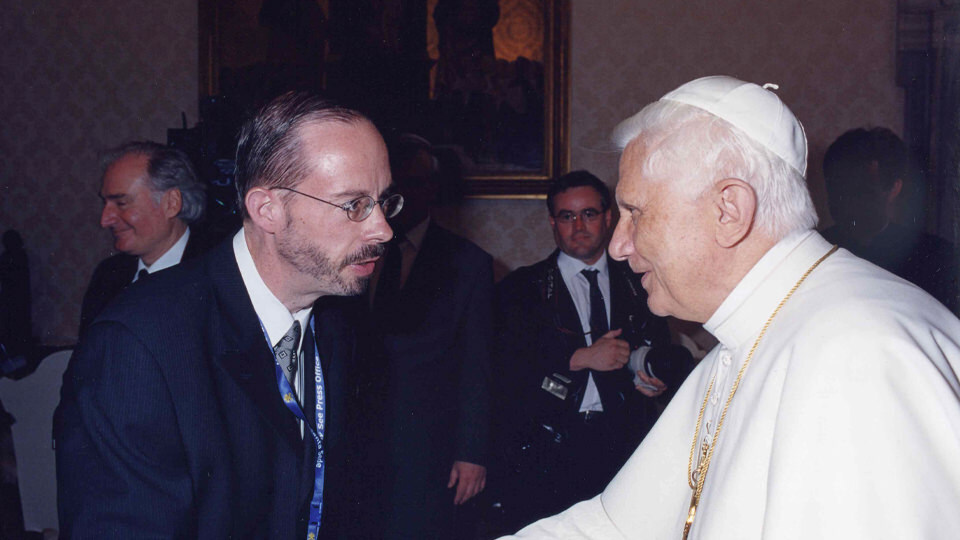
John L. Allen, Jr. with Pope Benedict XVI. John Allen was a multi-awarded Vatican journalist, known for his objectivity. Photo from Wikimedia Commons under the Gnu Free Documentation License.
John Allen Jr., a respected “elder statesman” of English-language Vatican news coverage, died this past January after a four-year fight with cancer. As I reflect on his legacy, I think about the way his commitment to clear, accessible, and truthful reporting calls us all to deepen our understanding of our neighbours and their perspectives – especially when we disagree with them. If we’re to honour his memory, we will allow this deepened understanding to help us build healthier and more united communities.
The first book of "Vaticanista" journalism I ever read was Allen's The Rise of Benedict XVI. I picked it up in 2011, towards the end of the scholar-pope's pontificate and around the time of my first year of MA studies at Regis College. I was struck by Allen's clarity and Vatican-insider knowledge, and enjoyed his down-to-earth tone that was tailor-made for North American audiences (he was fond of baseball metaphors!).
I was also struck by something deeper and more important: his ability to discuss the issues surrounding the 2005 Conclave with profound honesty. He cut through the pressures of competing biases and perspectives with the sharp sword of accuracy, comprehensiveness, and integrity. He presented the different positions and aims of the cardinals with the authority of someone who had earned the trust of an impressively wide range of Vatican officials, commentators, and others.
I can clearly recall a standout example of Allen’s clarity and honesty in The Rise of Benedict XVI to this day. Early in the book, he described a majority of the cardinals' sober assessment of the towering pontificate of John Paul II. The Polish Pope was universally beloved for his outgoing presence to the world, exemplified by a greater number of Apostolic Journeys abroad than all previous popes combined! However, those electing his successor were concerned that this international focus had come at the expense of managing the Curia at home. They were looking for the next pope to have a closer eye on bishop appointments, clergy discipline, and other "inside" matters.
That sober, trustworthy reporting was the hallmark of John Allen's career. I continued to follow his work with the National Catholic Reporter, then the Boston Globe, and ultimately with Crux, which began as a Boston Globe project before becoming an independent publication. I fondly recall "tuning in" -- it was on YouTube -- to Crux’s "Last Week in the Vatican." I found that his relatable tone and clear insights transferred seamlessly from the page to the screen.
What shone through was Allen’s deep love for the Church, for the journalistic endeavour, and for the truth. When I started following him, the internet was quickly becoming a haven for every viewpoint under the sun. It was already very easy for people and institutions to tell their stories to a wide audience, whether or not their message was supported by facts or reasoned arguments.
When broadcasting the stories of the Church, Allen always gave ample praise where it was due. When the Church’s pastors were true to their vocation of inspiring hope and trust in God and God’s people, he was sure to put that story front-and-centre. However, he also helped us understand that no one person is perfectly faithful to their vocation, that everyone has different strengths and weaknesses, and that even prelates can make missteps alongside great strides of leadership.
Above all, he helped us see that since we all have these different strengths and weaknesses, we all have to participate in this Church together. We can't afford to dismiss those who think differently from us, because there may always be something to learn from them. They can have experiences, wisdom, and creativity where we have a blind spot. That's why we have to understand their stories more clearly, and see our own just as clearly. We have to take their genuine, faithful, and truthful convictions into account, as well as the ways in which our own fall short. That humility is the first step in dismantling the polarization and distrust that has grown more strident in recent years, so we can begin to take part in the Holy Spirit’s work of drawing us all together in Christ.
At the root of his Spiritual Exercises, St. Ignatius of Loyola stunningly asserts that "it is necessary to suppose that every good Christian is more ready to put a good interpretation on another's statement than to condemn it as false" (#22). If this is true, then John Allen Jr. was truly one of the best, and helped us all be better Christians too.
We will surely miss his unwavering service to the Church and to the truth, his insights on Vatican "inside baseball," and his trustworthy and relatable reporting. However, we also hope to carry forward his legacy of inspiring unity through communication. We pray for his wife Elise and all who knew and loved him, and for his soul to know the eternal rest of Christ.
Allen graciously contributed to Salt + Light Media’s coverage of the 2013 Conclave that elected Pope Francis: he shared his insights in an extensive, 30-minute interview ahead of the election.

Share with friends:




Related Articles:
<<
SUPPORT LABEL
$50
$100
$150
$250
OTHER AMOUNT
DONATE
Receive our newsletters
Stay Connected


Receive our newsletters

Stay Connected