


Who is my neighbour? Hearing the cry | As I have loved you
Julian Paparella
Monday, February 23, 2026
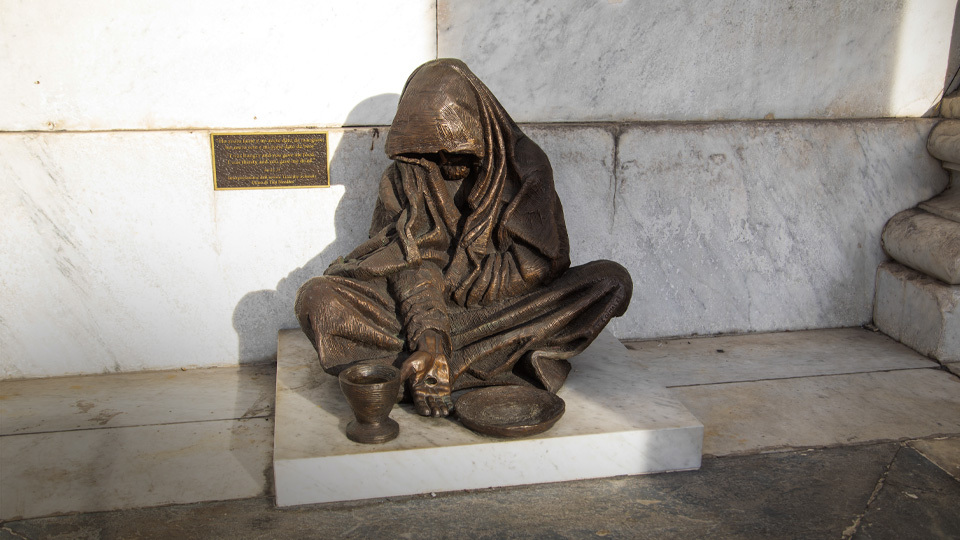
Sculpture of a poor person begging at a church. Photo by Yandry Fernández Perdomo on Cathopic.
Who is my neighbour? Hearing the cry
A reflection on Chapter 1 of Dilexi Te
Dilexi Te is the first major document of Pope Leo XIV. The exhortation, written on the topic of love for the poor, serves as a bridge between the two most recent pontificates. Begun by Pope Francis and taken up by Pope Leo, it was promulgated on October 4, 2025, the Feast of St. Francis of Assisi, who was renowned for his spirit of poverty. Leo’s namesake, Pope Leo XIII, is remembered most of all for his social teachings around the turn of the twentieth century. In the wake of the industrial revolutions, he advocated for the rights of workers and those who were disadvantaged by the leaps and bounds in technological progress occurring at the time. Over a century later, this new document by Leo XIV gives us an overview of the Church’s teaching on care for those who experience poverty, injustice, and exclusion in the twenty-first century. Above all, it is a call to see those in need as God does, loving them with his heart, spending time with them and being close to them, just as God is. This is a topic that puts us in touch with the very heart of the Gospel, which we are called to live out each day. This is especially true during the season of Lent. And so, on this journey towards Easter, we will reflect on one chapter of Dilexi Te per week. I invite you to join us.Speaking about “the poor”
At least in English, speaking about “the poor” can be rather loaded and risky. On the one hand, the Christian tradition points to “the poor” as people that are especially precious in God’s eyes, whom Christ calls everyone in society to love and serve on a daily basis as a matter of top priority. The Psalms tell us that “the Lord hears the cry of the poor” and that he is “near to the broken-hearted” (Psalm 34). In the Old Testament, God sees the misery of his people trapped in slavery, he hears their cry, and he comes to their rescue (Exodus 3:7-10). In the Gospels, Jesus not only ministers to those who are poor, but goes so far as to identify himself personally with them: “whatever you did to the least of these brothers and sisters of mine, you did it to me” (Matthew 25:40). On the other hand, actually referring to a specific person or group as “the poor” can be disparaging, removing their agency and reducing them to what they lack rather than recognizing all that they are. The point is not to avoid speaking about poverty, since that would only mask and underplay the stark reality that so many people experience in our own country and around the world. Rather, the balance to strike is to speak about poverty in a way that is sensitive, empathetic, socially conscious, and understanding towards the people who face it daily. Ultimately, it is not merely a matter of speaking about them or doing something for them, but rather listening to them, and doing something together with them. Multiple forms of poverty
Dilexi Te points out that there are many forms of poverty to take into consideration. There is material and economic poverty; but also social exclusion and marginalization; moral and spiritual poverty; conditions of fragility or vulnerability (whether physical, mental, or emotional, either temporary or permanent); and the political poverty of having “no rights, no space, no freedom” (#9). In a sense, every life involves a certain experience of poverty, the realization that we all lack something. None of us is self-sufficient. We all have moments of need; we all have wounds and weaknesses. However, we also realize that there are some of us whose situation in life is far more serious or acute than others. Sadly, those in greatest need are often on the sidelines of society. Oftentimes, we also keep them on the sidelines of our lives. In the light of our faith, what can we do to open our eyes, to extend our ears, and to reach out our arms?
Multiple forms of poverty
Dilexi Te points out that there are many forms of poverty to take into consideration. There is material and economic poverty; but also social exclusion and marginalization; moral and spiritual poverty; conditions of fragility or vulnerability (whether physical, mental, or emotional, either temporary or permanent); and the political poverty of having “no rights, no space, no freedom” (#9). In a sense, every life involves a certain experience of poverty, the realization that we all lack something. None of us is self-sufficient. We all have moments of need; we all have wounds and weaknesses. However, we also realize that there are some of us whose situation in life is far more serious or acute than others. Sadly, those in greatest need are often on the sidelines of society. Oftentimes, we also keep them on the sidelines of our lives. In the light of our faith, what can we do to open our eyes, to extend our ears, and to reach out our arms?
Hearing the cry
Dilexi Te states that the situation of those in need constitutes a “cry that, throughout human history, constantly challenges our lives, societies, political and economic systems, and, not least, the Church” (#9). Hearing this cry follows the example of God, who hears the cry of those in need and calls all of us to reach out to extend his loving embrace. God’s ears are open to hear their cry, and his heart is always open in solidarity with them. Yet our ears are often closed, and our hearts may remain indifferent to the struggles and difficulties of our brothers and sisters. What keeps us from hearing the cry? What keeps our hearts from being open? Leo XIV points to various mindsets and prejudices that can keep us from caring about those in need. Given the tremendous economic development of recent decades, we can be lulled into thinking that poverty is a question of the past, or even that those who experience it today must have done something wrong to get themselves into such a situation. Yet, as the pope affirms: “The poor are not there by chance or by blind and cruel fate” (#14). Rather, while “wealth has increased,” so too have inequalities (#13), such that the top tier of society is getting perpetually richer, while enormous swaths of the world have to contend with harsh living conditions. Here we can think of the growing reality of the “working poor” – those who “work from dawn to dusk […] know[ing] that their hard work will only help them to scrape by, but never really improve their lives.” This is only exacerbated by rapid technological progress in an age marked by the advent of AI, which further augments the risk of leaving huge segments of the population behind. Leo warns against a cruel prejudice which maintains that those who live in poverty somehow “do not ‘deserve’ otherwise,” and callously see “only the successful as ‘deserving’” (#14). Finally, Leo points out that we as Christians can also harbour prejudices against those who are poor:Christians too, on a number of occasions, have succumbed to attitudes shaped by secular ideologies or political and economic approaches that lead to gross generalizations and mistaken conclusions. The fact that some dismiss or ridicule charitable works, as if they were an obsession on the part of a few and not the burning heart of the Church’s mission, convinces me of the need to go back and re-read the Gospel, lest we risk replacing it with the wisdom of this world (#15).The question for each one of us is: How is Christ calling out to me in the voices of those who are poor and suffering? How can I allow my mindset to be shifted, on an ongoing basis, away from a logic of injustice and inequality towards the logic of the heart of the Gospel? Jesus, you who always hear the cry of those in need, open our ears to hear your voice speaking to us in theirs. Open our hearts and hands to serve you in them. Amen.

Share with friends:




Related Articles:
<<
SUPPORT LABEL
$50
$100
$150
$250
OTHER AMOUNT
DONATE
Receive our newsletters
Stay Connected


Receive our newsletters

Stay Connected