


The Grey Nuns: A Legacy of Faith and Service That Shaped Western Canada
Janelle Malkiewicz
Tuesday, June 30, 2026
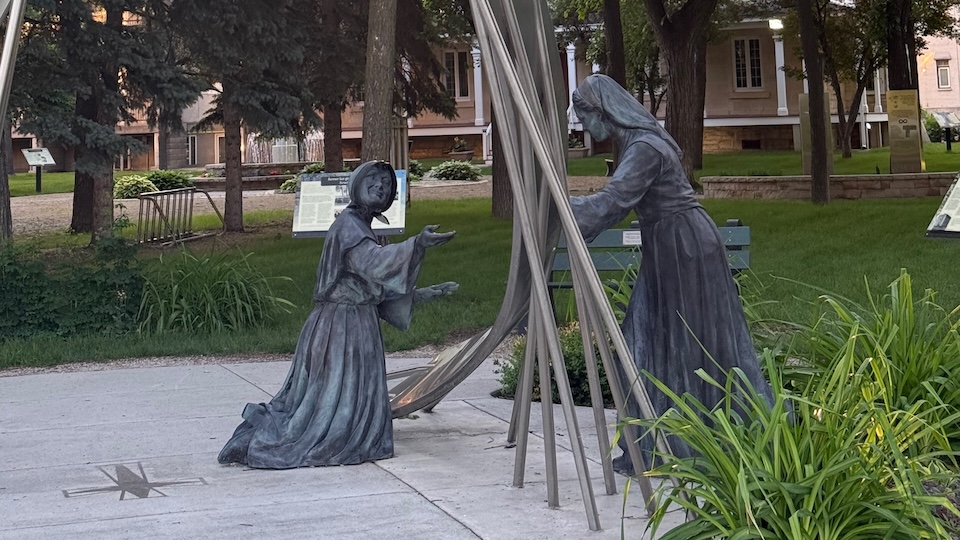
A pair of sisters serve each other in "In Honour of Women Religious in Manitoba," by Madeleine Vrignon. Located at the Archbishop of St. Boniface's Residence in Winnipeg, MB. Photo by the author.
The Grey Nuns hold a special place in my prairie heart. You can’t go very far in the community of St. Boniface in Winnipeg without seeing a piece of history dedicated to St. Marguerite d'Youville or her beloved Grey Nuns. Both of my children were born at St. Boniface Hospital, the very hospital that the order founded in 1871. To this day, St. Boniface Hospital is a member of the Catholic Health Alliance of Canada, and still maintains its Catholic roots all these years later.
From Mockery to Mission: Why “Grey Nuns?”
In 1737, Marguerite Dufrost de Lajemmerais and three of her companions consecrated themselves to work among the poor and help anyone in need. Today, the community they began is formally known as the Sisters of Charity of Montreal. However, the name “Grey Nuns” was originally adopted rather unfortunately. Marguerite’s late husband François d’Youville had been a bootlegger, an unsavory job smuggling prohibited alcohol for sale. Montreal residents mocked Marguerite and her companions as les grises – literally “the grey ones,” but commonly meaning “the drunken women” – as a dig at her late husband. However, that name is now one associated with healthcare and education across the country: the nuns reclaimed the name and adopted grey habits in 1755.Building a Nation's Healthcare
The 1840s were a decade of notable growth for The Grey Nuns of Montreal. In 1844, four sisters moved to St. Boniface after Bishop Provencher stated his desire to improve Christian education and training for young women to learn household tasks. The sisters provided a great help by teaching, as well as by caring for the sick and comforting the poor. They educated young boys and girls in the area, including the Sauteux, Métis, and Sioux communities. In 1847, After carrying out numerous homecare visits to care for the sick in the area, they opened one of the rooms of their newly built convent as a hospital room. From there, after making around 6000 home visits from 1844-1855, a 4-bed dispensary to care for the sick was opened in 1871. This was the foundation of St. Boniface Hospital, the first hospital in Western Canada.Setting Educational Standards
Then in 1869, Bishop Provencher once again reached out to the Grey Nuns present in the Red River Settlement (present-day Winnipeg) and requested they open a school. Maison Ste. Marie was opened shortly after, making it the first Catholic school in the Red River settlement, across the river from St. Boniface. In 1870, a chapel was built enablingCatholics in Winnipeg to attend mass. This established what we now know as St. Mary’s Cathedral, the Mother Church of the neighbouring Archdiocese of Winnipeg. From 1871-1872, 34 students, male and female, were enrolled at Maison Ste. Marie. Today, that school is known as St. Mary’s Academy. However, the Grey Nuns no longer oversee the operation of the school. Their time there was meant to be temporary as Archbishop Taché had recruited the Sisters of the Holy Names of Jesus and Mary to take care of the school.The Gateway to the West
Writing this article certainly led me to research more about the Grey Nuns and add to my own knowledge of their impact on my own neighbourhood. Most of the photos included in this article are of sites that I walk by everyday. A group of women, founded and rooted in Christ’s mission, knew what their work was about and led their lives striving to help every soul they encountered. Whether that was through education, healthcare, or simply companionship, these women are the reason for numerous organizations and “household names” in Winnipeg today. There are organizations I hear about or encounter daily that the Grey Nuns had an initial influence on. This includes many schools, support centres for people with developmental disabilities, homes that care for elderly people with complex needs, and of course, the second largest hospital in Manitoba. If you’re ever visiting Winnipeg, I encourage you to visit the grounds of St. Mary’s Academy, St. Mary’s Cathedral, and the St. Boniface Heritage Gardens to walk in the footsteps of these great Canadian women. Winnipeg is often called the “gateway to the West,” and I think that name is especially true when we consider that the missionary work in the prairies started here. From this initial call to help in the Red River Settlement, the Grey Nuns came to serve in Alberta, Saskatchewan, North West Territories, and eventually into the United States as well. Learn more about Canadian Catholic history and our treasury of Canadian saints in our collection of documentaries and features.




Related Articles:
<<
SUPPORT LABEL
$50
$100
$150
$250
OTHER AMOUNT
DONATE
Receive our newsletters
Stay Connected


Receive our newsletters

Stay Connected