


Dante’s Lessons for Today
Christopher M. Bellitto
Tuesday, March 17, 2026
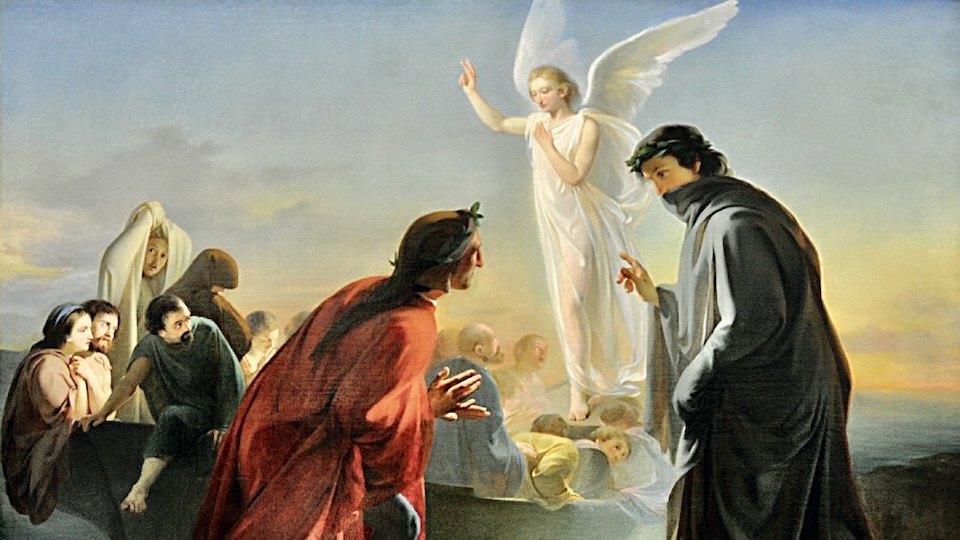
Domenico Morelli, "Dante and Virgil in Purgatory" Palazzo della Prefettura, Naples. Wikimedia Commons.
Why has division come to be our default position? We struggle to find common ground on fundamental questions. We can't agree on what justice means for all members of society. Some even question whether compassion, empathy, vulnerability, and charity are virtues or vices. It can be hard to move forward with integrity and principles.
We can either be grumpy or try to make things better. Dante Alighieri (1265-1321) is someone who tried to teach us how to make things better. He is the poet from Florence who described a poetic vision of hell, purgatory, and heaven in his Divine Comedy. One of his central lessons is that getting knocked down by vice is an opportunity to learn its redeeming virtue.
Hoarders and Spenders
For Dante, hell is a world of malignant narcissists who think they are always right and that other people exist only to serve them. His guide, the ancient Roman poet Virgil, indicts them for having “lost the good of the intellect” (Inferno III.18). Their mindset is, “If you can help me, fine, but even if you do, once you are no longer useful to me, you are cast away. Loyalty flows only one way: to me.” They are people who just use others for their own gain. They may even enjoy hurting others because it makes them feel good. A person fueled by vice and selfishness harms not only himself, but the people around him. In hell, Dante meets someone he knew in Florence named Ciacco. Ciacco was a glutton,a play on the medieval Italian word for pig. He is condemned for his pride, envy, and greed. Ciacco tells Dante that many Florentines are now in hell because they were greedy- they kept hoarding money and power but were never satisfied by it.. Ironically, they are paired there with people who lost all their money by spending without thought — fools both. Both groups now spend eternity banging into each other in a medieval version of bumper cars. They still rant about how much they want or how much they need, still full of their desire for more, more, more, now, now, now. The hoarders and spenders crash together, then separate and do it all over again forever, and everyone gets hurt. These condemned souls are always grasping and instigating, gaining and losing, but ending up with nothing but futility.Rulers and Minions
Anger is a vice that also harms not only individuals, but communities as well. Dante’s Exhibit A is Filippo Argenti, a thoroughly unlikable fellow: vain, arrogant, greedy, and prickly.When in the world, he was arrogant; there is no good to adorn his memory: so his shadow here is furious. How many above now consider themselves great kings, who will wallow down here like swine in a trough, leaving behind only horrible contempt! (Inferno VIII.46-51)Dante moves onto other vices, and really gets going when he presents liars, deceivers, and flatterers — minions with no chance at power themselves but attach to awful leaders instead. They ride their coattails like parasites, hurting other people brutally and enjoying being in the inner circle, though they may yet find themselves cast aside by the very narcissists they sacrifice their dignity to serve. Dante sees such souls covered with excrement. He names one of them as Alessio Interminei, who admits, “So low have I sunk myself by the flatteries which my tongue never tired of speaking” (Inferno XVIII.125-26).
Virtuous Transformation
But there is hope: virtue can conquer vice. In Dante’s world, the only way to get rid of a vice is to find the corresponding virtue and work hard to move from the bad to the good. Guido del Duca, for example, was a member of one of Ravenna’s power families. In purgatory, he describes himself as a person so full of anger at other’s good deeds and fortunes that he’s purple with rage. But already he’s gotten an insight:O humankind, why do you put your hearts where sharing cannot have a part? (Purgatorio XIV. 86-87)Guido realizes that cooperation, not competition, is the right path. Mercy for others, and not envy at private gain, is what helps everyone together. Then there’s empathy: feeling sorrow and joy with others, helping to raise those below, caring for others as you would have them care for you. Prudence or good judgement is another virtue that Virgil wants Dante to appreciate. It resists false certainty and embraces doubt — quite unlike only following blogs or podcasts that tell us what we want to hear in our safe bubbles. Good judgement asks questions rather than receives without thought or critique. It lives in a real world of grey instead of ideological white and black. Why did Dante take the time to share what he learned about virtue and vice? It turns out that when he met his great-great-grandfather Cacciaguida in the afterlife, the old man told Dante:
Make all of your vision clear to everyone; And let them scratch where the itch is. (Paradiso XVII.128-29)It’s time to find our own itches and scratch to make them better. Christopher M. Bellitto is Professor of History at Kean University in Union NJ. This essay is adapted from his latest book, Walking Toward Virtue: A Journey with Dante (Liguori Publications).

Share with friends:




Related Articles:
<<
SUPPORT LABEL
$50
$100
$150
$250
OTHER AMOUNT
DONATE
Receive our newsletters
Stay Connected


Receive our newsletters

Stay Connected