


Monaco welcomes the Pope of Unity
Matthew Neugebauer
Wednesday, March 25, 2026

Monaco welcomes the Pope of Unity
Leo XIV visits the luxurious micro-state navigating a rich Catholic identity and a cosmopolitan global embrace
The leaders of the two smallest countries in the world are set to meet this Saturday morning. Pope Leo XIV will travel by helicopter to the Principality of Monaco, the luxurious micro-state along France's Mediterranean coast. He'll visit Prince Albert II, meet with lay leaders and youth, and end the day presiding over Holy Mass in Louis II Stadium before returning to Vatican City, again by helicopter.A Catholic City-state
Pope Leo will bring words of encouragement to Monaco’s historic Catholic community: 90% of the 10,000 native Monégasque citizens are Catholic. Their heritage of faith runs deep, and has been especially resilient since the ruling Grimaldi family regained the territory in 1419. In 2025, Minister of State (Prime Minister) Christophe Mirmand asserted that “this religious and even spiritual dimension is not a secondary element that can be removed with the stroke of a pen.” Rather, he said that Monaco’s Catholic heritage is an “essential component” underlying the city’s “identity…shared values, and…conception of solidarity.” Monaco’s richly Catholic soil is continually nurtured at the highest levels. Albert was formally enthroned in the Cathedral of Our Lady Immaculate by Archbishop Bernard Barsi during a Solemn Mass in July, 2005. His father and predecessor Rainier III, like all previous Princes of Monaco, had been buried in the cathedral three months before. The 1962 Constitution enshrined Roman Catholicism as the state religion, reflecting the centuries-long place of the Church at the centre of the city’s life. The constitution continues to uphold the right to freedom of religion, the legislative powers of the elected National Council, and other democratic reforms of the Constitution of 1911. For the most part, the relationship between the Catholic identity of the native population and the religious diversity of its foreign nationals is a comfortable one. However, that relationship was tested last year, when the National Council adopted a proposition to permit first-trimester abortions. Albert and his Executive Council refused to pass the legislation: while announcing that the prince would exercise his veto, Mirmand held that a law permitting abortions would upset Monaco’s “collective equilibrium" by going against its Catholic identity. Albert's decision puts him in the company of other European Catholic monarchs tasked with upholding traditional Catholic values in a rapidly secularising context. Pope Francis addressed very similar circumstances when he visited Belgium in 2024 and hailed King Baudoin's agonizing choice in 1990 to temporarily abdicate rather than approve that country's abortion bill. This Saturday's visit will be Pope Leo's first to a western European country outside of Italy. He too will speak to the struggle and opportunity of what Pope Benedict XVI called the "creative minority" of Catholics in contemporary Europe, where people are encountering each other more frequently and sharing a more diverse range of perspectives, backgrounds, and religious beliefs. Benedict strongly encouraged Catholics to dialogue with the world and contribute to their societies, and at the same time called them to proclaim the truth, goodness, and beauty of the Christian faith. Watch Pope Leo XIV’s Apostolic Journey to Monaco this Saturday, March 28 on Salt + Light TV and Salt + Light Plus. Here is our full schedule: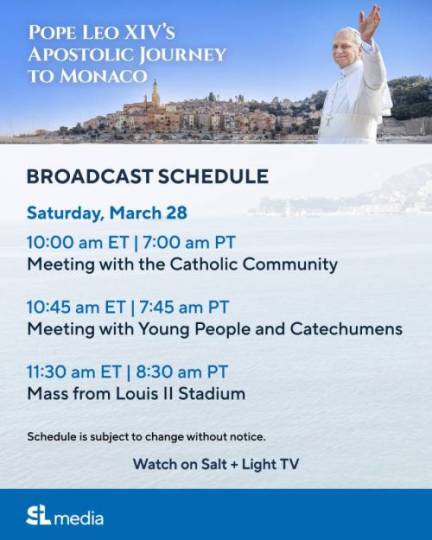
A Haven of Wealth
Alongside lauding the importance of preserving the life and dignity of the unborn, Leo XIV might also proclaim another fundamental Christian value: justice and solidarity throughout society amidst the widening gap between the rich and the poor. Monaco’s geography and economics call for this proclamation of solidarity in unique ways. With an area just shy of 2.1 square kilometres, it has the distinction of being the second-smallest country by area, outdone only by Vatican City's .49 square kms. However, it also has the second-highest population density in the world – 19,044 people per square km – and the highest concentration of millionaires, 30% of its 39,000 inhabitants. The country’s world-famous casino, its status as a tax haven, its high-profile Formula One race, and its stunning location on the French Riviera make it a prime destination for the super-rich from all over the globe. While poverty is virtually non-existent among Monaco’s residents, the ever-increasing density and skyrocketing real estate prices have pushed lower-income support staff beyond the city-state’s borders. In 2024, of the 65,000 workers who serviced the elite, over 48,000 commuted daily from nearby parts of France and Italy. In such a lavish setting, Pope Leo XIV might take the opportunity to remind the 29,000 non-Monégasque residents about the moral and spiritual dangers of excessive affluence. He might also draw attention to the difficulties faced by these commuting private-sector workers, and call for practical responses to alleviate them. In his Apostolic Exhortation Dilexi Te, he raised concerns about “the growth of a wealthy elite, living in a bubble of comfort and luxury,” unaware of the suffering of those who are poor and hungry (#11). The Holy Father has centuries of good will, rooted in Monaco’s Catholic heritage, to draw on as he makes his appeals to defend the dignity of life from conception, to natural death, and to everyone in-between. He will likely commend the faith of the Monégasque people as they enter Holy Week and might also point to the city government’s wide range of social support that full citizens can enjoy. The Principality’s official site boasts universal free education, government-ensured housing, state-of-the-art digital and public security, and a comprehensive public health insurance system. All of these policies suggest that Monaco is capable of being a beacon for Catholic faith, solidarity, and unity across borders. In a world of contrasting voices that pit economic progress against human dignity and social well-being, perhaps the “pope of unity” will shine a spotlight on Monaco’s struggles and impressive strides at maintaining both fidelity to Tradition and a vibrant welcome to the world at the same time.



Related Articles:
<<
SUPPORT LABEL
$50
$100
$150
$250
OTHER AMOUNT
DONATE
Receive our newsletters
Stay Connected


Receive our newsletters

Stay Connected